
Satire 101: A Guide to Political Satire
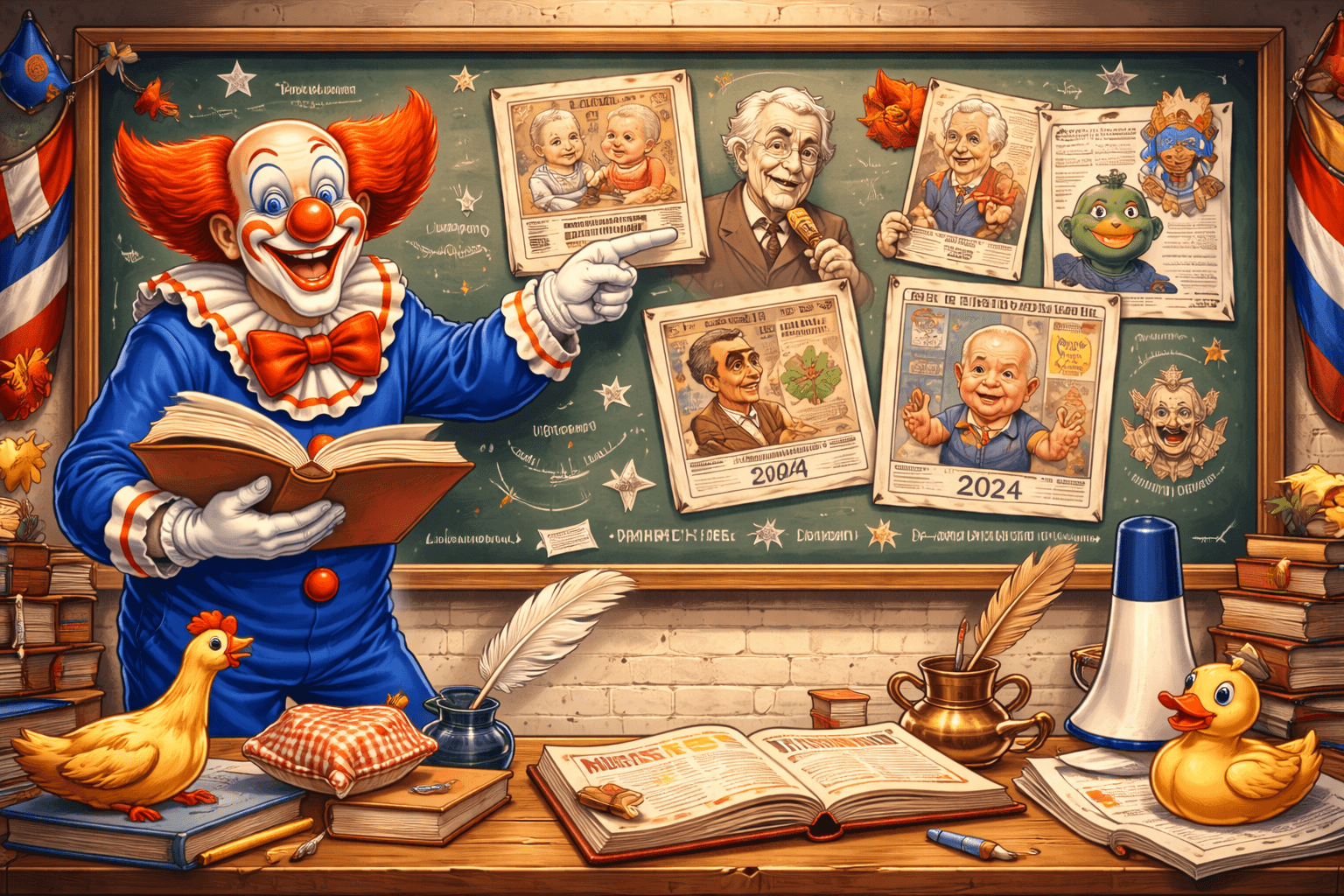
Welcome to Satire 101 on PolicyClown.com — your ultimate primer on the art of political satire. From ancient Greek playwrights mocking war-hungry leaders to modern AI-generated memes skewering policy blunders, political satire has been humanity's witty weapon against power for millennia. This page dives deep into its definitions, history, techniques, and cultural impact, with real-world examples and links to explore further. At PolicyClown.com, we channel this timeless tradition by using AI to transform today's headlines into hilariously exaggerated policy predictions — because if politics is a circus, satire is the clown car.
What is Political Satire?
Political satire is a genre of humor that employs irony, exaggeration, ridicule, and parody to critique politics, politicians, governments, and societal power structures. It's not just about laughs; it's a form of social commentary designed to expose hypocrisy, corruption, incompetence, and absurdity in public life. By amplifying flaws to ridiculous levels, satire encourages audiences to question authority and reflect on real-world issues.
Key Characteristics
- •Exaggeration: Amplifying problems or traits to absurd extremes, making them impossible to ignore (e.g., suggesting extreme solutions to highlight policy failures).
- •Irony: Stating the opposite of what's meant, often to underscore contradictions (e.g., praising a flawed leader in overly glowing terms to reveal their shortcomings).
- •Ridicule & Caricature: Mocking individuals or ideas through exaggerated depictions, like cartoons that enlarge physical features to symbolize personality flaws.
- •Parody: Imitating political styles, speeches, or formats while twisting them for comic effect (e.g., fake news headlines that mimic real media).
- •Purpose: While entertaining, satire often aims to provoke change or awareness without direct advocacy. It's grounded in truth but delivered with a punchline.
Unlike straightforward criticism, satire thrives on subtlety and wit, making it a powerful tool in democracies where free speech allows it to flourish. For more on the basics, check out Wikipedia's entry on Political Satire.
At PolicyClown.com, we embrace satire by generating absurd policies tied to real headlines — turning serious news into over-the-top forecasts that poke fun at political overreach.
History of Political Satire
Political satire has evolved alongside human society, from ancient oral traditions to digital memes. Wherever power exists, satire follows to challenge it. Below is an expanded timeline with key milestones.
- 5th BCE
Ancient Greece - Aristophanes
Playwright Aristophanes, often called the "Father of Comedy," pioneered political satire in works like The Clouds (423 BCE), which lampooned philosopher Socrates as a charlatan, and Lysistrata (411 BCE), where women withhold sex to end the Peloponnesian War. His plays ridiculed Athenian leaders and war policies during public festivals. Read more on Aristophanes via Britannica.
- 1st CE
Ancient Rome - Juvenal & Horace
Poets like Juvenal and Horace wrote biting satires exposing corruption and moral decay. Juvenal's Satires critiqued Roman society with vitriol, coining phrases like "bread and circuses" to mock public manipulation. Explore Juvenal's works on Project Gutenberg.
- 1511
Renaissance - Erasmus
Erasmus' In Praise of Folly (1511) ridiculed church corruption. In England, Shakespeare's plays like Richard III (1593) can be seen as satirical takes on tyranny. Early political cartoons emerged, like those by William Hogarth in the 18th century, critiquing social vices.
- 1729
Jonathan Swift - "A Modest Proposal"
This infamous essay sarcastically suggested that Ireland's poor sell their children as food to the rich, critiquing British exploitation and famine policies. It's a pinnacle of ironic satire. Full text available on Project Gutenberg.
- 1754
Benjamin Franklin - "Join, or Die"
America's first political cartoon urged colonial unity against Britain, using a severed snake as a metaphor. It marked the rise of visual satire in the colonies. See it on Britannica.
- 1873
Mark Twain - The Gilded Age
Twain (Samuel Clemens) satirized American politics, imperialism, and hypocrisy in works like The Gilded Age (1873), coining the term for the corrupt post-Civil War era. His anti-imperialist essays mocked U.S. expansionism. More on Twain at PBS American Experience.
- Late 1800s
Thomas Nast's Cartoons
Nast popularized symbols like the Republican elephant and Democratic donkey while exposing New York's Tammany Hall corruption. View his works on the Library of Congress.
- 1945
George Orwell - "Animal Farm"
An allegory of the Russian Revolution, where farm animals revolt only to face new tyranny. It critiques totalitarianism universally. Read it on Project Gutenberg Australia.
- 1962
Rise of Television Political Satire
Shows like That Was The Week That Was (UK, 1962) brought live mockery of politicians to TV, influencing U.S. programs and paving the way for modern political comedy.
- 1975
Saturday Night Live Debuts
SNL revolutionized satire with sketches impersonating presidents (e.g., Chevy Chase as clumsy Gerald Ford). It continues to skewer politics weekly. Official site: NBC's SNL.
- 1996
The Daily Show Transforms News Satire
Under Jon Stewart (1999–2015), it became a faux-news show critiquing media and politics, inspiring spin-offs like The Colbert Report. Watch clips on Comedy Central.
- 2000s
Internet Memes and Digital Satire
Platforms like Reddit and Twitter (now X) democratized satire, with memes mocking elections. Social media allowed anyone to create and share satirical content instantly, changing the landscape of political humor forever.
- 2018
The Babylon Bee
A conservative satirical site with headlines parodying progressive policies, often fact-checked mistakenly as real news. Visit The Babylon Bee.
- 2020s
AI-Generated Political Satire
Tools like Grok and sites like PolicyClown.com use AI to create instant, absurd predictions. In 2025–2026, AI memes targeted events like the 2024 U.S. election aftermath and global AI policy debates. For modern examples, see The Onion, which pioneered fake news headlines since 1988.
For a full timeline, refer to Britannica's Brief History of American Political Humor.
Key Elements of Effective Satire
Effective political satire balances humor with insight. Here's a deeper look:
Exaggeration
Taking real positions to absurd extremes, like Swift's child-eating proposal, to highlight societal flaws. It amplifies truths for impact and makes problems impossible to ignore.
Irony
Using sarcasm to expose hypocrisy, as in Orwell's "All animals are equal, but some are more equal than others" from Animal Farm. Irony reveals contradictions between words and actions.
Parody
Mimicking formats, like The Onion's fake articles or SNL's debate sketches, to mock originals. Parody imitates style while twisting content for comic effect.
Truth-Based Humor
Grounded in facts for credibility — satire fails if it's just nonsense. As Mark Twain said, "The secret source of humor itself is not joy but sorrow." The best satire builds on reality.
Learn more techniques from Smart Blogger's Satire Examples.
Satire vs. Misinformation
In today's fake-news era, distinguishing satire from deception is crucial.
Important Distinction
Satire is labeled as humor and exaggeration, never intended to deceive. Misinformation spreads false claims as facts, often harming society. Good satire makes you think critically while laughing, whereas misinformation deliberately misleads.
- ✓Satire: Clearly exaggerated, uses humor to critique or comment (e.g., labeled parodies on SNL). It's presented with context that signals it's not real news.
- ✗Misinformation: Presented as truth, intends to mislead (e.g., deepfakes or conspiracy theories). It deliberately obscures the fact that it's false.
The U.S. Supreme Court upheld satire's protections in Hustler v. Falwell (1988), affirming First Amendment rights. Read about it on Penn State's Probing Question.
Why We Need Political Satire
Political satire is vital in democracies. It serves several important functions:
- •Holds power accountable by exposing abuses
- •Makes politics accessible to non-experts through humor
- •Encourages critical thinking and debate
- •Provides comic relief in tense times
- •Exposes hypocrisy and narrow-mindedness
- •Strengthens free speech by testing boundaries
As VOA notes, satire is "as old as politics" and essential for healthy discourse. VOA Article on Political Satire.
Further Reading
Ready to See Satire in Action?
Dive into our AI-generated absurd policies on PolicyClown.com. Check out today's predictions combining real news with over-the-top forecasts that poke fun at political overreach.
View Today's PredictionsThanks for exploring Satire 101 — now go forth and question everything with a smile!